C. S. Lewis's service during World War I
Surprised by JoyC. S. Lewis’s First World War service took him from Oxford to the front line in France, where he encountered the war’s privations, its ordinary soldiers, and the abrupt transformation of a life still organized around books and study. In his retrospective account, military service is neither an uncomplicated adventure nor simply a sequence of battlefield events: it is an imposed interruption that could foster comradeship precisely because no one pretended it was pleasant, and whose most persistent memory was an imaginative recognition of war as something already known through Homer.
From Oxford to the Army
Lewis came into residence at University College in the summer term of 1917, still facing the elementary mathematics examination known as Responsions. He had failed it at Easter, and remained unsure whether he sat it again and failed again. The uncertainty ceased to matter when a decree exempted former servicemen after the war; without that exemption, he thought, he might have had to abandon Oxford. His immediate purpose in entering residence was to join the University Officers’ Training Corps, which appeared to offer his most promising route into the army.
The college term was already far from ordinary. Half of University College had been converted into a hospital and occupied by the Royal Army Medical Corps; the undergraduates lived in the remainder. The small group numbered about eight and included two students not yet of military age, two considered unfit, a Sinn Féiner unwilling to fight for England, and several others Lewis did not quite place. They ate in a small lecture room that later served as a passage between the Common Room and Hall. Lewis enjoyed the company, which included E. V. Gordon, A. C. Ewing, and Theobald Butler, but described the period as unsettled, excited, and generally unproductive rather than as a normal undergraduate experience.
Less than a term after his arrival, Lewis’s papers came through and he enlisted. He was drafted into a Cadet Battalion billeted at Keble College, passed through what he recalled as a comparatively mild training course, and received a commission as a Second Lieutenant in the Somerset Light Infantry, formerly the XIIIth Foot. The sequence brought his Oxford plans and his military future together, but only briefly: university life had given way to preparation for service before it could become routine.
The Front and Its Conditions
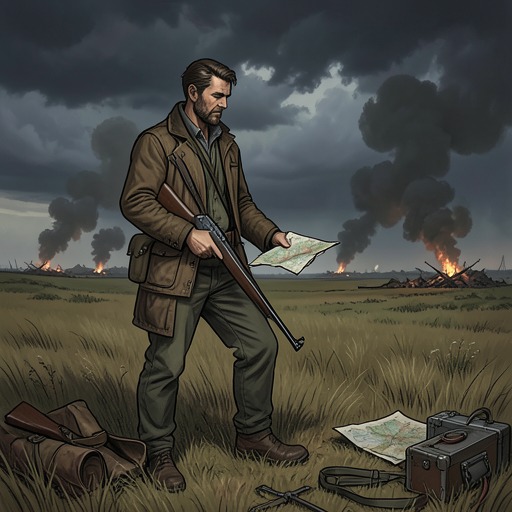
Lewis reached the front-line trenches on his nineteenth birthday in November 1917. Most of his service was in villages before Arras, including Fampoux and Monchy. In April 1918 he was wounded at Mt. Bernenchon, near Lillers. He offers these points of military chronology without claiming to provide a comprehensive account of the war, noting that others who saw more of it had described it often.
Until the major German attack in the spring, his unit had a relatively quiet period. When the attack came, the Germans struck the Canadians to the right; Lewis’s line was subjected instead to shelling intended to keep it quiet, at a rate he recalled as roughly three shells a minute throughout the day. He remembered meeting a shivering mouse during that bombardment and understood its failure to flee as an instance of a greater terror overcoming a lesser one: both animal and man were afraid.
In winter, weariness and water were persistent adversaries. Lewis recalls falling asleep while marching and waking to find himself still on the move. In the trenches, water stood above the knees of men wearing thigh-high gum boots; concealed barbed wire could puncture a boot and let an icy stream in. These details set the bodily routine of service against the larger, more spectacular image of battle. For Lewis, the day-to-day exposure to cold, exhaustion, and wet ground formed the practical texture of the front.
Soldiers, Memory, and Meaning
The service altered Lewis’s judgment of the ordinary soldier. He came to know, pity, and respect men whose experience differed sharply from his own as a young and, in his retrospective assessment, ineffective officer. He singled out Sergeant Ayres, who appears to have been killed by the same shell that wounded him. Lewis remembered himself as a puppet moved about by Ayres, while the sergeant transformed that unequal, awkward relation into something beautiful and became almost a father to him. The memory makes the war’s human bonds more consequential than rank alone: Lewis’s account locates care and authority in a relationship that exceeds its formal military arrangement.
Lewis did not remember the war as an uninterrupted catalogue of its worst sights. Cold, explosive smells, shattered men, corpses, a landscape reduced to earth, and boots worn day and night appear in his account, but he says that these realities return rarely and faintly and can seem to have happened to someone else. He connects his knowledge of the dead with the view of corpses formed when he first saw his dead mother. That earlier experience gives his wartime recollection a personal frame, but he does not present it as a simple explanation of the war or as a substitute for what happened at the front.
One moment, by contrast, retained particular imaginative force: the first bullet Lewis heard, distant enough to sound like the kind of bullet described by a journalist or a peacetime poet. Its significance lay not in proximity to danger but in recognition. He understood it as a signal that this was the war Homer had written about. In the memoir’s ordering, a brief sound therefore outlasts much of the service’s physical detail: the event entered memory as both a present danger and an encounter with the literary past.
The War Compared with School
Lewis’s recollection of army life is shaped by comparison with his earlier experience at Wyvern. He calls the army detestable, but stresses that no one claimed it ought to be enjoyable, and no one pretended to enjoy it. Soldiers accepted it as an odious necessity and an interruption of rational life. That candour, in his account, made hardship easier to bear than suffering imposed by an institution that advertised itself as pleasurable. Shared adversity could produce camaraderie and, under intense conditions, a kind of love between sufferers; concealed resentment and mutual distrust were more likely where hardship was disguised as enjoyment.
He also found his military seniors kinder than the senior boys at Wyvern. His explanation is partly a difference of age: a grown adult dealing with a nineteen-year-old, he suggests, has less need to assert himself than a nineteen-year-old dealing with a thirteen-year-old. He adds that his own expression may have changed, perhaps after reading Phantastes, so that a look he had been told to remove had given way to one that invited pity or kindly amusement. At the same time, his account includes no general claim that war was benign. The contrast is narrower and more pointed: an openly acknowledged ordeal could permit mutual sympathy where compulsory hardship disguised as pleasure had bred distrust.
The war thus appears in the memoir both as lived military service and as a test of how suffering is named. Its chronology runs from Oxford residence in 1917 to the trenches before Arras and a wound in 1918, but its remembered significance gathers around contrasts: the small college community and the front, the fatigue of routine and the extraordinary terror of shelling, the officer’s formal rank and Sergeant Ayres’s almost paternal care. The first bullet’s Homeric echo finally joins experience to imagination without erasing the war’s material conditions.